7,321
outbound actions logged over 92 days
A frozen snapshot. The ledger keeps writing.
The record
Every figure comes from a single frozen source of record and carries its window. The claim that did not survive review is on this page too, because that is the part that makes the rest worth reading.
Method
There is a single source of record for the figures on this site, frozen as a snapshot on 12 August 2026. Nothing is estimated, nothing is rounded up into a better story, and any figure that could not be traced back to a counted source was removed rather than softened. Where a number has a caveat, the caveat travels with it on the same screen.
A number without its unit and its window decorates a page. It cannot support a claim. Ranges are published as ranges. Self-assessed fields are labelled as self-assessed. A measurement that turned out not to hold is deleted from the marketing material rather than reworded.
Reliability
| Measure | Value | Note |
|---|---|---|
| Work orders | 1,195 | Live queue and archives. |
| Results on disk | 929 | Includes orphaned or unlinked results. |
| Tasks with a linked result | 839 | The measurement base. |
| Work orders with no result | 356 | 29.8% of all work orders. |
| Clean on first attempt | 532 | The upper end of the range. |
| Partial | 177 | 21.1% of the base. |
| No outcome label | 112 | 13.3% of the base. |
| Full failure | 10 | 1.2% of the base. |
| Escalations to a human | 96 | The system stopping and asking. |
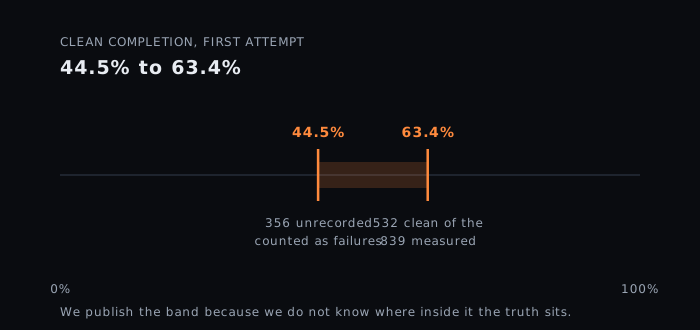
The upper end, 63.4%, counts 532 clean results against the 839 tasks that have a linked result. The lower end, 44.5%, counts the 356 work orders with no result record as failures, against all 1,195. Neither end is the truth on its own, which is why the range is published rather than the number that flatters.
The outcome field is written by the executing agent about its own run. This is self-assessment and not independent review. It is the weakest link in the measurement and it is stated everywhere the range appears.
Throughput
7,321
outbound actions logged over 92 days
A frozen snapshot. The ledger keeps writing.
484
uptime checks per day
An infrastructure measure. It says the system is up, and says nothing about whether an agent did good work.
101
scheduled business automations
75 ran in the 24 hours before the audit and 89 in the week before it. 11 of the 101 currently return a non-zero exit code.
A new runtime layer was built on 6 August 2026. The first six flows were migrated onto it from Windows Task Scheduler and ran 4,365 flows with 16 failures. The rest of the scheduled work is still on the old scheduler, and the migration is happening in waves.
Review
An earlier draft of our own material carried a reliability headline over a multi month window. The claim was checked before publication and rejected as wrong. The measurement window was 5.24 days, not months. The overwhelming majority of the runs came from two polling loops rather than from business work, and the two together account for 99.1% of them. Inside that flattering average, one real flow, the invoice pipeline, had failed 5 times out of 8.
The claim never went out. It was removed from every asset and replaced with the runtime wording above. This is what the review layer is for, and it is the reason to trust the numbers that survived it.
833 of the 839 measured tasks ran once only, and 6 got a second attempt that already carried information from the first. pass^k cannot be derived from a historical record like that, so we built a harness that starts every attempt from a clean workspace, enforces a negative control, and requires an explicit reversibility approval. It is public under MIT at github.com/oreno334/passk. There is no canonical score for this system, and results will be reported separately.
Outcome
The advertising this system runs returns close to a tenfold return as Google measures it. That is ad platform attribution and not audited sales, and the distinction matters enough to print next to the figure rather than in a footnote.
Alongside it, the same system operates a store assistant with 458 customer conversations and 2,595 messages since May, and a messaging worker handling live customer traffic. These are operational counts from a real business, which is the only kind of evidence this site publishes.
Every figure on this page has a boundary, and the boundaries are published in the same voice as the numbers. What we do not claim is the canonical limits record, in full, including the parts that are unflattering.
Tenant isolation. Tenant isolation is built and tested, and it has not been proven in production. 213 tests pass across 14 suites, and 11 of the 12 isolation guards are enforced. The twelfth guard waits on an explicit, documented decision. There is no paying external tenant.
Product and onboarding. This is not yet a self-serve product. The system is tailored to a single operator, and a new organisation would need specification and onboarding work before it could run this.
Reliability measurement. pass^k cannot be derived from the historical record, so we built a harness that starts every attempt from a clean workspace. 833 of the 839 measured tasks ran once only. Harness results will be reported separately.
Human oversight. The unsupervised dispatch layer has been off since 19 May. The operating mode is supervised concurrency, with a demotion to L2 before money, publishing, or a message to a customer.
Limits the audit exposed.